

The former paratrooper fighting Land Rover to build the Army’s next 4x4
Gareth Reece believes Fering’s British-made vehicle can beat the industry’s heavyweights

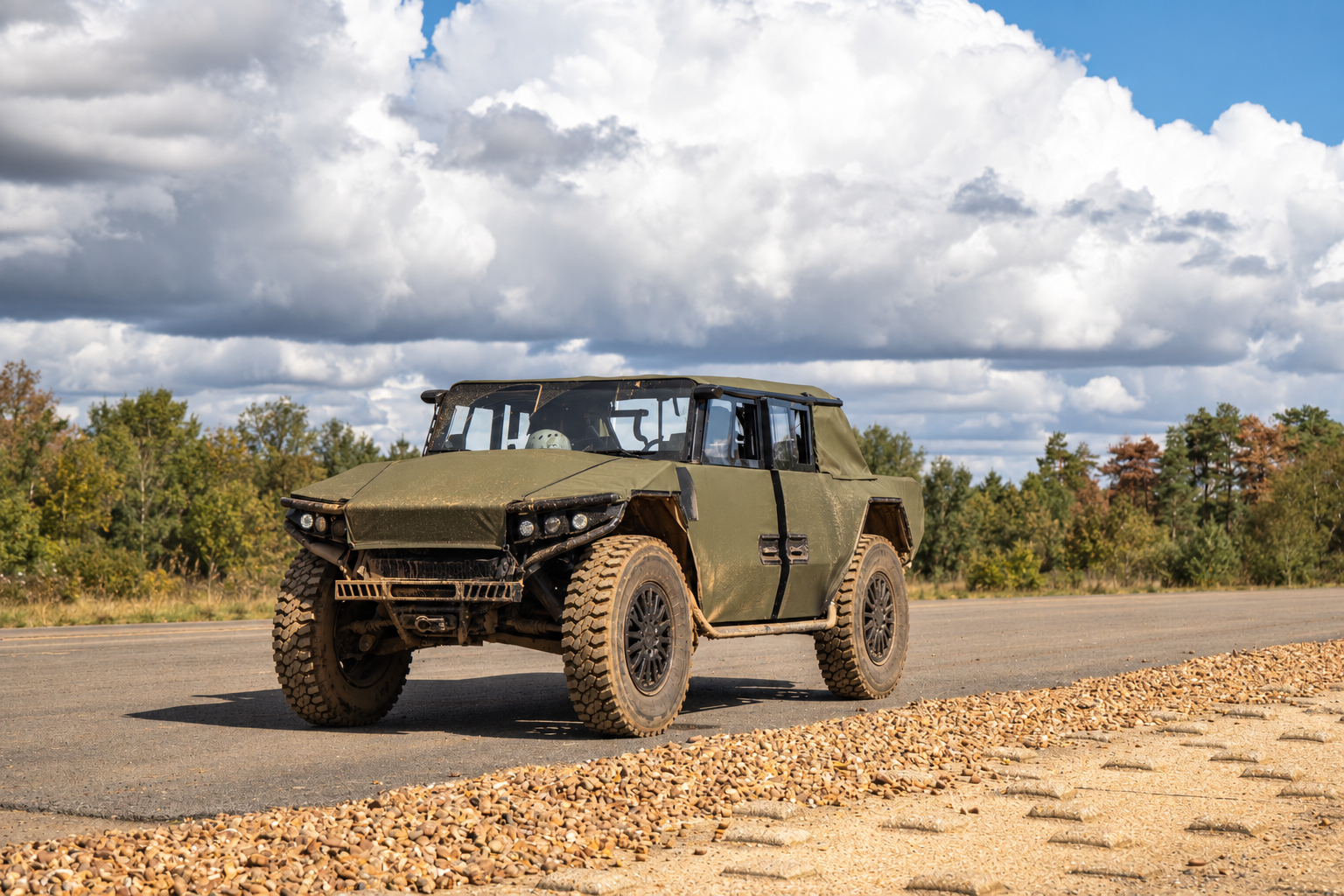
“It’s an incredible machine – I wish I had one of these when I was doing my thing in the military,” says Gareth Reece.
The former paratrooper is standing in front of the rugged but stripped-back military vehicle that Fering, his company, is pitching to the British Army.
Complete with a large gun turret, the car is an impressive sight. Reece, the managing director of Fering, argues it is precisely the kind of modern vehicle soldiers need on the battlefield.
A diesel-fuelled, hybrid-electric 4x4, the Pioneer X is designed for reconnaissance missions and special forces operations that penetrate deep into enemy territory.
Because it runs off four small batteries, the car can be very stealthy: it has almost no heat signature and can operate silently for up to 50 miles.
Not to mention, it can also act as a mobile power plant for forward bases – even providing enough electricity for a ground-based radar system.
Rather than being a drawback, Reece, 48, argues that the car’s electrified powertrain is an advantage.
It is fuelled by diesel, meaning it is just as easy to supply as existing vehicles, but its generators then charge the batteries, giving it all the advantages of an electric car as well. There are also fewer moving parts than a combustion engine – meaning there’s less to go wrong.
Through the combination of its batteries and a generator, the Pioneer can go for 4,350 miles non-stop on a full tank of fuel – enough to drive all the way from London to central Mongolia.
“Everything’s been designed from the ground up,” Reece adds, “so you can make the most of the efficiencies that a hybrid-electric drive can offer.
“We want to see these vehicles in the British military. We think our servicemen and women should have the best.”
The Pioneer X is Fering’s offering for the Army’s £2.5bn contract to replace its fleet of 6,000 Land Rovers, which have been in service for decades.
In the past week at the DVD defence show, senior British military officials and their Nato counterparts have been putting the Pioneer through its paces at the Millbrook proving ground in Bedfordshire.
They are understood to have been impressed by what they saw. But Fering is still a relatively small company, and it is the underdog in what is shaping up to be a heavyweight contest.
Some of the world’s biggest defence companies are bidding for the Land Rover contract, including Jaguar Land Rover itself.
Specifications released by the MoD require there to be nine variants, including a special forces rig and a battlefield ambulance, while the cars must also be “modular” – so they can have new technologies easily installed in future.
“You might not have noticed, but apparently there’s some vehicles being exhibited out there,” joked Luke Pollard, the defence minister, in a speech to gathered industry executives.
Ironically, what most of them have in common is that they are proposing vehicles based on foreign-built chassis – even as they emphasise the Britishness of their various offerings.
Babcock, the domestic defence giant, is proposing a “best of British” vehicle based on the Toyota Land Cruiser, for instance, while Sir Jim Ratcliffe’s Ineos Automotive has offered a militarised version of its Grenadier Quartermaster – the base of which will be made in France.
Other rivals include General Motors and General Dynamics, which are respectively proposing versions of Chevrolet and Ford Ranger pickup trucks made in the US and Thailand respectively.
German giant Rheinmetall has also put forward a vehicle adapted from the Mercedes-Benz G-Class, while even JLR is proposing a version of the Land Rover Defender that is built in Slovakia.
JLR, like its competitors, has stressed that all the military conversion work would take place in the UK.
This is where Reece, who spent 14 years in the Army as a paratrooper and later a helicopter pilot, believes Fering is genuinely different.
After leaving the Army, Reece worked in the UAE for the presidential guard, and later as a consultant. During his time in the Gulf, officials took an interest in Fering’s lightweight vehicles, acquiring two, with Reece ultimately ending up working for the start-up.
Founded in 2019 by Ben Scott-Geddes, an automotive engineer, Fering says the percentage of British content in the Pioneer X is in “the high 90s”.
One of the only foreign components is its battery, which is made by Japan’s Toshiba.
“This is a UK company, it’s UK design, innovation, engineering,” says Reece. He says Fering’s entry can outperform anything being put forward by the competition and deserves serious consideration.
Its hybrid system means it is more expensive per unit – in the low hundreds of thousands of pounds – but can go for even longer distances than other cars, with fewer refuelling stops.
‘This is not a novelty’
That is partly thanks to the eclectic mix of engineers who designed it, and who have taken a creative approach to solving various challenges through the use of high-tech components and composite materials.
Many have previously worked in Formula 1, and for McLaren, Mercedes-Benz and Ferrari.
One even designed the Batmobile for Christopher Nolan’s Batman films.
“We’ve got some really capable people here,” Reece says. “All of our technicians have worked in really high-end automotive.”
One doubt rivals raise about Fering is its scale. But the company insists it is ready for the big time and is lining up an as-yet unnamed major manufacturing partner who could mass-produce the car – the MoD says it would need up to 9,000 – in Britain.
What Reece wants most, he says, is for his plucky British company to get a fair hearing.
“We just want to elbow our way in,” he says. “Everyone loves the engineering, but then they’re asking ‘Can it really go into theatre?’
“The answer is yes. This car can get over terrain that the others just can’t. It’s not even comparable. This is not a novelty.”
The billion-pound question is whether the Army will believe him.