

The Fering Pioneer, Welcome to the Future
Fering exhibited their Pioneer hybrid vehicle at DVD2026, and we came away convinced that we have seen the future of both vehicle design and what can be achieved from hybrid electric powerchains.
Let’s not beat around the bush, an overriding imperative for a lot of the contenders for the LMV contract is that sales of internal combustion vehicles are decreasing, so a big juicy multi-year contract from the UK Government would be manna from heaven. Which is why we’re seeing big hitters like JLR, Ford, Mercedes and Toyota eager to compete.
Would an electric solution for the LMV work?
Well there’s only one, the Fering Pioneer. We’re not saying that electric vehicles are the answer to everything, but Fering have answered so many of the demands of the modern battlefield so comprehensively and elegantly in the hybrid power Pioneer that it seems the perfect solution. It would also be a tacit acknowledgement of the 100% British design and manufacture that it embodies, not something that many of the other bidders can boast of.
Challenging a legacy mindset in UK land power
Fering’s Pioneer platform is being pitched as much more than another light military vehicle: in the words of Gareth Reece, Fering’s Chief Commercial Officer at Millbrook, its main differentiator from legacy platforms is that “it is a mobile generator.”
Founded in 2019 as an expedition vehicle manufacturer focused on sustainable mobility in remote and hostile environments, the company has since expanded into three main markets: defence, commercial (with interest from mining, agriculture and forestry), and potential private sales from next year.
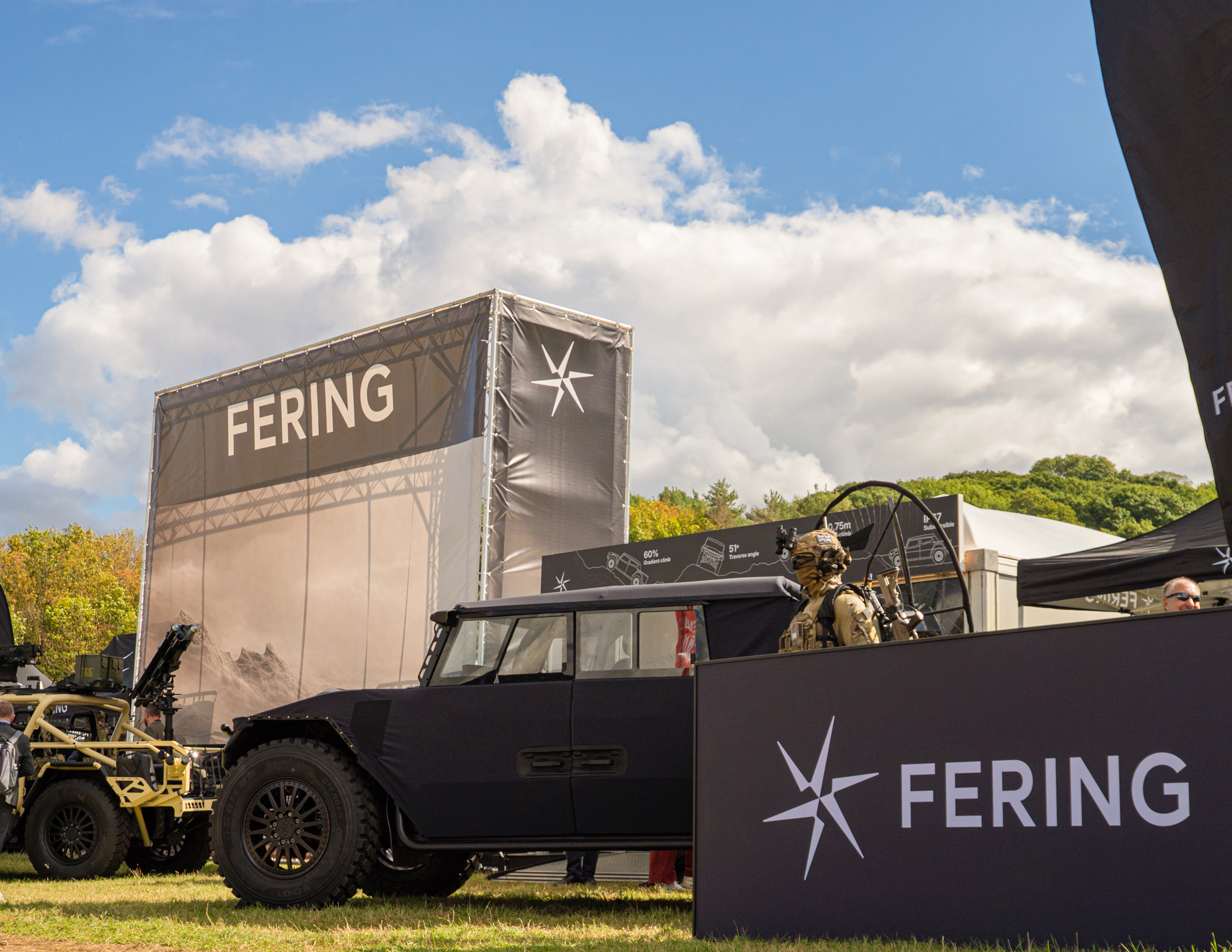
The Fering approach
The Pioneer is built around a hybrid architecture, with a large central tub housing all the fuel and electric motors front and rear delivering around 490 Nm per motor – just under 1,000 Nm of instantaneous torque. A pneumatic suspension system with individual axle articulation and redundancy allows the vehicle to raise by around 500 mm, delivering what the team describes as “hypermobility” and step‑climb capability of roughly 800 mm.
Range is central to Fering’s case. With an incredible 490 litres of diesel on board and a conservative planning assumption of 40 mpg, the Pioneer is quoted a mind bending 7,000 km range on a single fuel load, depending on mission profile and conditions. The company argues that if commanders are “having to refuel this vehicle 10 times less than a legacy vehicle, that gives you a huge amount of reach and sustainability.”
Logistics, they repeatedly stress, is the real battlespace, citing the familiar maxim that “amateurs talk about tactics… professionals talk about logistics”, positioning Pioneer as a way to shrink the refuelling and support tail while increasing available electrical power at the fighting echelon.
The export power proposition is explicit. With up to 60 kW on tap, a full tank can, they claim, “run a four‑bed home for around about four months.” That surplus power is framed as an enabler for ISR payloads, electronic warfare, advanced communications, ground radar and, in time, directed‑energy systems, as well as non‑combat roles such as desalination and disaster relief, where “you need mobility, comms and power.”
Construction
Architecturally, the vehicle separates a ‘roller skate’ lower chassis – containing drive, suspension, braking, fuel and electrics – from an agnostic upper structure. With eight bolts, “we can lift the upper frame off the roller skate,” allowing role changes or deep refurbishment. Axle modules are universal and plug‑and‑play, enabling operators to swap them forward with minimal tooling. Current payload is cited around 1.8 tonnes, close to a one‑to‑one payload‑to‑weight ratio, and a 6×6 extended variant adds another tonne of payload for roughly 250 kg extra weight.
The vehicle is drive‑by‑wire and described as “optionally manned”, with the team already talking in terms of human‑machine teaming, autonomy and the ability to task the vehicle for unmanned resupply or CASEVAC missions.
Fering is keen to contrast this with the LMV programme’s emphasis on “heritage and the past” and the extension of “legacy plus plus” platforms. The Pioneer, they argue, is unconstrained by inherited design choices of mass‑market OEMs: “We sit down with the user and we say, right, what are your requirements? Because we’ll give you the solution, not a solution.”
This theme is reinforced by partner firm Powersize.tech, represented by Wiktor Dotter, which has worked with DSTL and international customers on the hybridisation and electrification problem set. He notes that many current platforms are “underpowered,” unable even to support modern radios, let alone high‑end sensors: “You can’t have a V8 rattling just to keep the teapot on, right?”
To address this, Wiktor’s team built a mission‑based modelling tool to compare different hybrid architectures. One on-screen example showed a General Motors ISV with an 80 kW battery and 60‑litre tank versus Pioneer’s 15 kW battery and 450‑litre tank – across realistic cycles. Users can define terrain, gradients, silent running requirements and onboard loads (lasers, SATCOM, computing), then see the resulting fuel and battery burn and required refuelling events.
In another Strait of Hormuz based scenario, the GM design required 10 refuels for a single patrol, while the Pioneer finished the cycle with around 70% fuel remaining. When a nominal refuelling event is applied, Wiktor argues that “you’re almost saving a million,” even when assuming a “provocative” acquisition cost for Pioneer at up to three times that of a conventional alternative.
The same tool has been extended to stationary scenarios, including replication of the British Army’s PCC6 exercise in a forward operating base configuration. Here, Pioneer functions as a mobile power station alongside solar, batteries and legacy generators, with the model used to test resilience and “push back the refuelling convoy” under different failure and surge‑demand conditions.
For the UK MOD, the combined pitch is that there is no single “Prius moment” yet in defence, but there is now a way to interrogate trade‑offs between payload, power, range and logistics burden – and that a British‑designed vehicle, built around hybrid power, digital integration and modularity, offers a credible route away from incremental “heritage” upgrades.
It is really heartening to see a British company start from scratch and mature so quickly to be a serious contender for the LMV project. You can see the established motor manufacturers involved bringing their business big guns to bear on the tender, whilst others capitalise on a sense of heritage and ‘Britishness’ that proves to be paper thin when you look under the hood. Fering have shown us the future with the Pioneer, the MoD need to be brave enough to commit.